I Was Invited to a Buddhist Ordination in Thailand — What I Experienced
by Mário Ferreira | March 2026 | Daily Life
It is five in the morning. Music is already echoing through the small town of Na Di, a few kilometres from Surin, in Isaan. A 20-year-old man has decided to become a Buddhist monk for a period of his life. And I, the village farang, am invited.
This kind of moment you won’t find in any tourist guide. It is lived, it is shared — and it stays with you.
Becoming a Monk in Thailand: Not Necessarily for Life
In the West, we often imagine monastic life as a permanent commitment. In Thailand, it is different.
Any Thai man can choose to become a monk from the age of 20 — and can leave whenever he wishes, simply by informing his temple’s superior. It takes just one day to resume normal life.
This practice is deeply rooted in Thai culture. Spending a period at the temple is a way of earning ‘merits’ — for oneself, but also for loved ones, and in particular for one’s parents. It is an act of filial respect as much as a spiritual one.
🛏️ Historical note: the late King Rama IX was himself a monk for fifteen days. During this period, the Queen served as regent of the kingdom.
It is therefore quite natural that parents organise a grand celebration for this decision. In a village as small as Na Di, ‘family and friends’ means… almost everyone.
The Celebration — A Full Day of Music, Dance and Joy
The day begins before dawn. The music — a blend of Thai and Khmer sounds — will not stop until nightfall.
The Morning: the Rituals
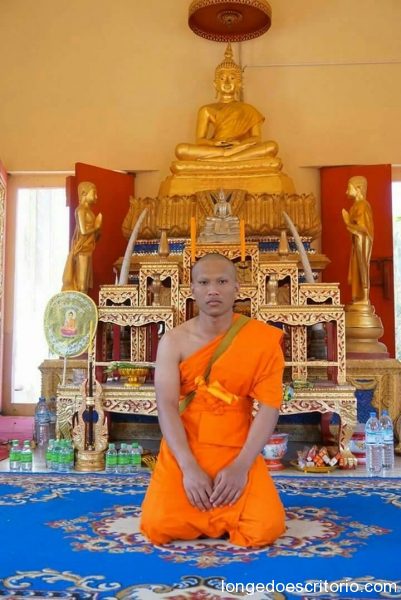
Rituals follow one another throughout the day: Buddhist chants, prayers and collective dances around the future monk. One of the most solemn and visual moments is the shaving — the candidate’s head and eyebrows are completely shaved, symbolising detachment from the material world.
Tables laden with food and drinks are set out to welcome all guests. In a culture where hospitality is a fundamental value, no one leaves hungry.
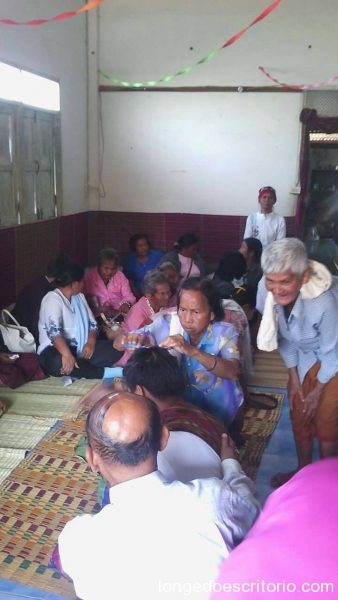
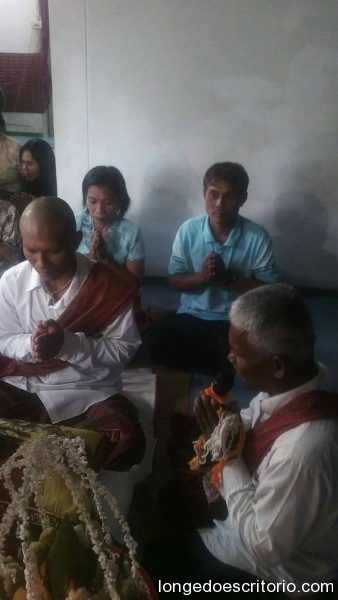
The Evening: Khmer Music
As night falls, a Khmer music orchestra takes over the outdoor stage. The music is hypnotic — the traditional Khmer fiddle weaving a bewitching melody, punctuated by ‘héé, héé, héééé…’ thrown off-beat by the singers.
The hosts take to the stage to thank each guest. And there, a surprise was waiting for me.
😄 The hosts gave me a special mention. Apparently, a farang present at an ordination ceremony in an Isaan village is not something you see every day. I stood up, thanked them in Thai and did a wai — that joined-hands gesture Thais use to greet, thank or say goodbye. Smiles all around. The night was going to be long.
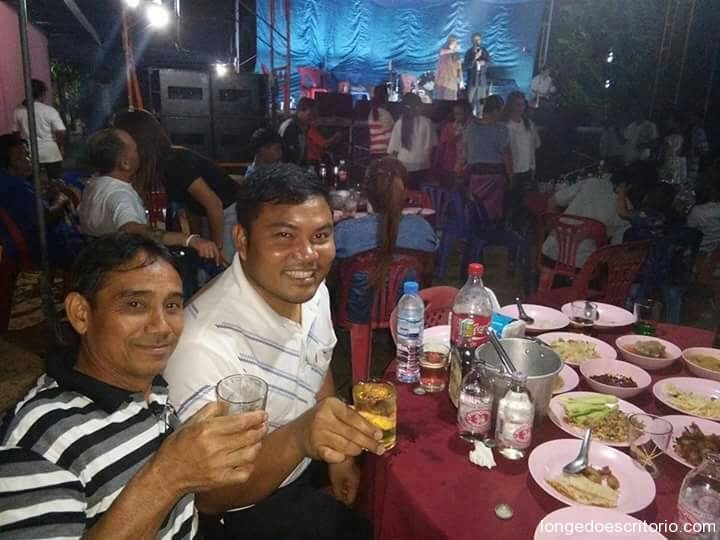
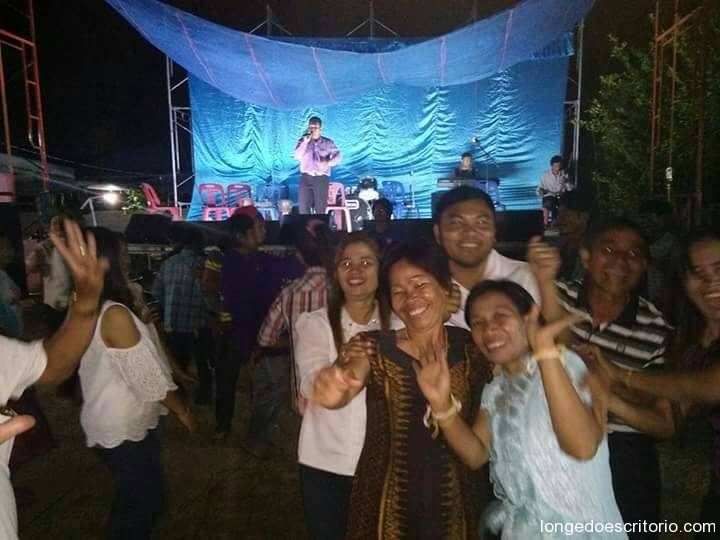
The Next Day: the Ordination Ceremony
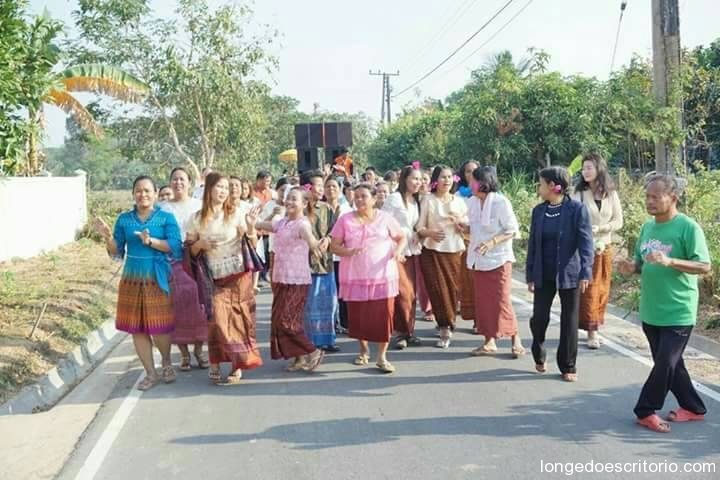
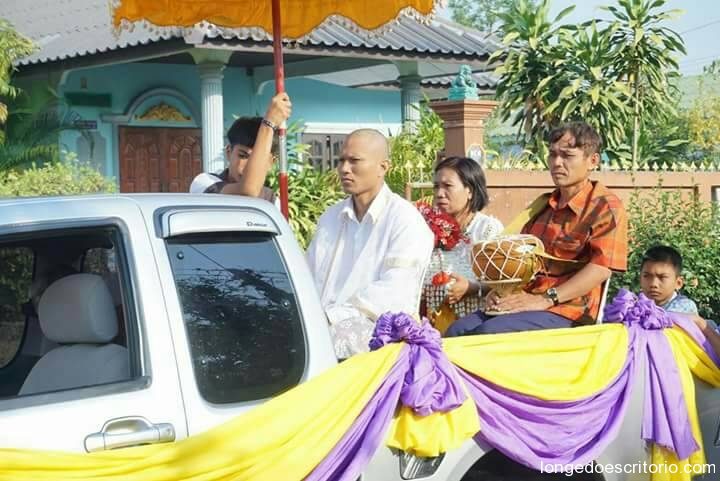
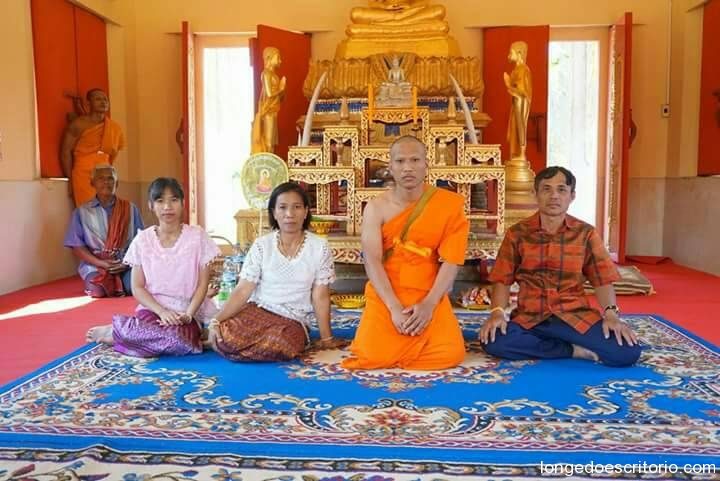
The following morning, the candidate dons white garments symbolising purity. A joyful procession — family, friends, music — accompanies him to the temple.
The Ordination Questions
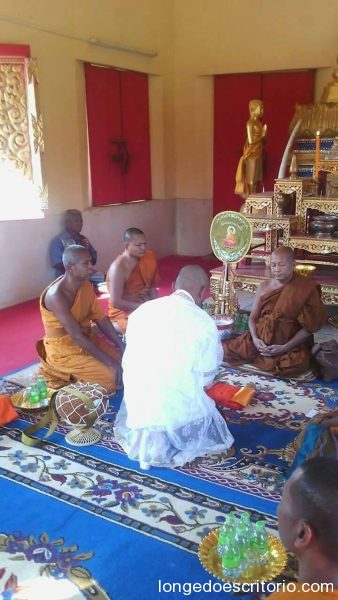
At the temple, a series of questions is solemnly put to him before he can be accepted as a monk. Here are some examples:
- Do you have tuberculosis? (No)
- Do you have epilepsy? (No)
- Are you a human being? (Yes)
- Are you a man? (Yes)
- Are you free of debts? (Yes)
- Do you have your parents’ permission? (Yes)
💡 These questions may raise a smile, but they have serious logic: they ensure the candidate is entering monastic life freely, in good health, and without unresolved obligations.
If all answers are satisfactory, the candidate is officially ordained as a monk. He must now observe 227 rules of conduct — governing everything from food to sleep, including social interactions.
What This Day Taught Me About Thailand
Buddhism is Not a Surface Religion
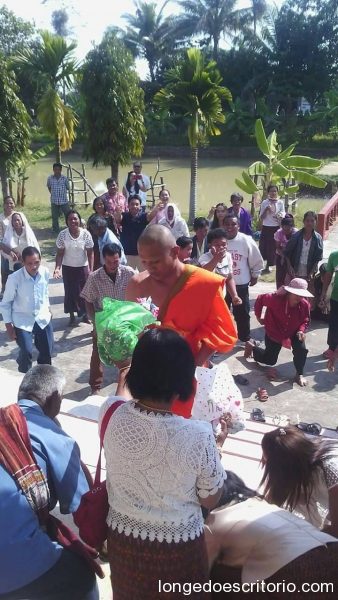
For many Westerners, Thai Buddhism is summed up by the gilded temples photographed on holiday. But in Na Di, that morning, I saw something different: an entire community mobilising, singing, dancing, crying with joy — because one of their sons chose, freely, to dedicate a period of his life to spiritual practice.
Community Above All
In Isaan villages, the boundary between neighbours and family is blurred. A celebration is everyone’s affair. Everyone cooks, everyone serves, everyone dances. And the foreigner — the farang — is welcomed without reservation, with benevolent curiosity and sincere generosity.
The Wai — Much More Than a Gesture
The wai (ไหว้) is the Thai gesture of joined hands, accompanied by a slight bow of the head. It expresses respect, gratitude and greeting. Learning to do it correctly — and using it at the right moment — radically changes the way Thais perceive you. That evening in Na Di, it earned me smiles I will not forget.
If You Are Invited to a Buddhist Ceremony in Thailand
These moments cannot be bought at a travel agency. They happen when you live here, when you learn the language, when you integrate into the community. But if the opportunity arises, here are some tips:
- Always accept the invitation. It is an honour and a privilege.
- Dress modestly — cover shoulders and knees. White or light colours are appropriate.
- Learn a few words of Thai — even basic ones. Sawadee krap/ka (hello), khob khun krap/ka (thank you), and a well-executed wai will work wonders.
- Observe before acting. Follow what others do, especially during ritual moments at the temple.
- Don’t refuse food that is offered. It is a fundamental gesture of hospitality.
- Turn off your phone or put it on silent during religious ceremonies.
In Summary
That day in Na Di remains one of my most memorable experiences in Thailand. Not for the gilded temples or paradise beaches — but for that rare feeling of being accepted, for the duration of a celebration, into the heart of a community that lives differently.
That is the real Thailand. The one that doesn’t appear in the brochures.
— Mário Ferreira | Surin, Isaan, Thailand
💬 Have you been invited to a similar ceremony? Share your experience in the comments!
📌 Also read: Phanom Rung — The Khmer Temple I Had All to Myself, and our guide to the colours of the days of the week in Thailand.