Scorching Heat, Soaring Bills: Mastering Electricity Costs in Thailand in 2026
If you’re moving from Europe or North America, prepare for a shock. Not just a thermal one — though that too — but more importantly, on your electricity bill. In Thailand, air conditioning isn’t a luxury: it’s a medical necessity. When temperatures hover between 40-45°C during the hot season, sleeping without AC is simply not a reasonable option for most expats.
The result: electricity is often the expense that surprises new arrivals the most. Here’s everything you need to know to understand, anticipate and — if possible — reduce the bill.
Expert tip: if your electricity bill is higher than your rent, something is wrong. Either your air conditioner dates from when Thailand was still called Siam, or your landlord is billing you creatively.
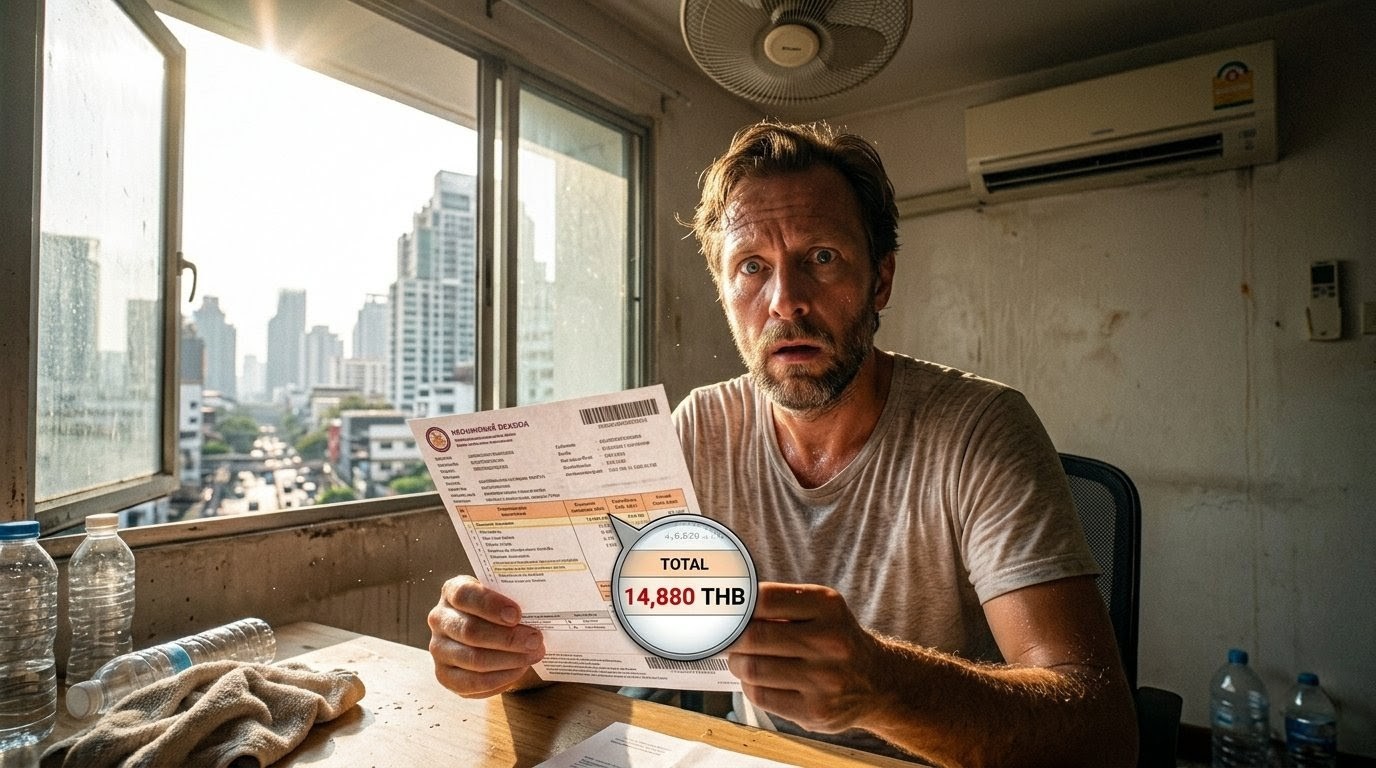
The 2026 Context: Why Bills Have Gone Up
New Tariffs from 1 May 2026
The Energy Regulatory Commission (ERC) announced on 1 April 2026 a modest tariff increase for the May-August 2026 period:
- Current rate (January-April 2026): 3.88 THB/kWh
- New rate (May-August 2026): 3.95 THB/kWh — a 1.8% increase
This modest rise could have been far more severe. The ERC had initially considered options of 4.08 and even 4.59 THB/kWh, driven by surging LNG (liquefied natural gas) prices linked to Middle East tensions. The chosen solution uses 9.4 billion baht from a “clawback” mechanism — surplus revenues from electricity authorities — to absorb most of the increase.
The Ft Component: What Is It?
Your electricity bill has two parts:
Base tariff — fixed at 3.78 THB/kWh. This covers the cost of the grid infrastructure.
Ft (Fuel Tariff) — variable, currently at 0.1623 THB/kWh. This is the adjustment the ERC reviews every four months based on the cost of fuels used to generate electricity, primarily imported natural gas. When LNG is expensive (as now due to geopolitical tensions), the Ft rises. When prices fall, it can drop — and even turn negative, which actually reduced bills in 2023-2024.
Ft + base tariff = 3.95 THB/kWh (before 7% VAT)
Air Conditioning: Why Bills Spike
A standard 12,000 BTU AC unit (typical for a bedroom) consumes between 1,000 and 1,500 Wh per hour. In peak season, running at 26°C, it easily runs 10-12 hours a day. Do the maths: 1.25 kWh × 12h × 30 days × 3.95 THB ≈ 1,778 THB/month for a single bedroom unit alone.
Add the living room, fridge, washing machine, computer, and a bill of 3,000 to 5,000 THB/month for a one-bedroom apartment is entirely normal during the hot season.
MEA vs PEA: Who Supplies Your Electricity?
In Thailand, electricity distribution is handled by two distinct authorities depending on your location:
MEA (Metropolitan Electricity Authority) — serves Bangkok and its immediate surroundings (Nonthaburi, Samut Prakan). If you live in the capital, MEA manages your meter and sends your bill.
PEA (Provincial Electricity Authority) — serves the rest of the country, meaning virtually all of Thailand outside Bangkok. In Isaan, Chiang Mai, Phuket: that’s PEA.
Base tariffs are identical between MEA and PEA — the tariff structure is national. The difference lies in their online services, mobile apps, and local responsiveness during outages.
Paying your bill: both authorities offer online payment (MEA/PEA app), at 7-Eleven, via PromptPay QR code, or directly at the local office. Bills are monthly and typically arrive at the start of the month.
The Landlord Surcharge: The Most Important Point for Expats
This is what nobody tells you before you sign your lease — and it can double your electricity bill.
How It Works
Many older apartments, serviced apartments, and some rental buildings don’t give you direct access to the utility authority’s bill. The landlord receives the official bill (≈ 3.95 THB/kWh) and re-invoices you at a flat rate — often 7 or 8 THB/kWh, nearly double.
It’s Illegal — But Common
Thai law has been clear since 2018: landlords managing three or more rental units cannot charge electricity above the official tariff. The Office of Consumer Protection Board (OCPB) tightened enforcement of this rule further in late 2025.
But in practice, most foreign tenants are unaware, and landlords continue. Some justify the surcharge through common areas (lifts, corridors, exterior lighting) — a grey area that the law hasn’t fully resolved.
How to Protect Yourself
- Before signing, ask explicitly: “What is the per-unit electricity rate, and who receives the official bill?”
- Get the answer in writing in the lease
- Photograph your meter monthly with a visible date
- If you pay the official rate directly to MEA/PEA, you’re guaranteed to avoid any surcharge
- For disputes, contact the OCPB at 1166 or the Consumer Council at 1502
Money-Saving Strategies: Surviving the Bill
The 26°C Rule
The Thai government officially recommends setting air conditioning to 26°C rather than 20°C, combined with a ceiling or standing fan. The thermodynamic logic is simple: each extra degree of cooling increases consumption by about 6 to 8%. Moving from 20°C to 26°C can reduce AC consumption by 30 to 40% — while staying comfortable if a fan circulates the air.
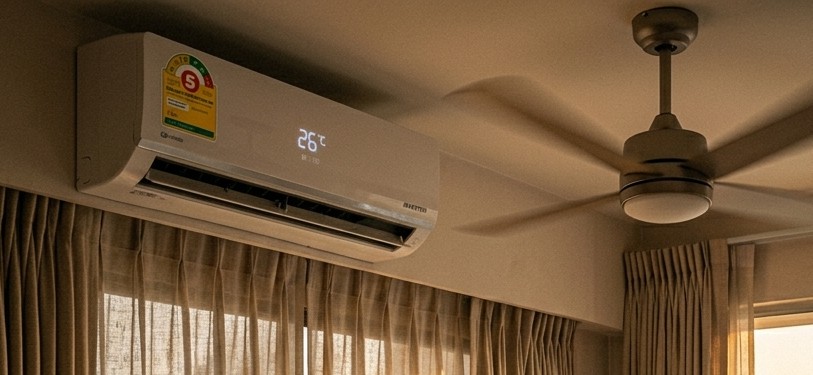
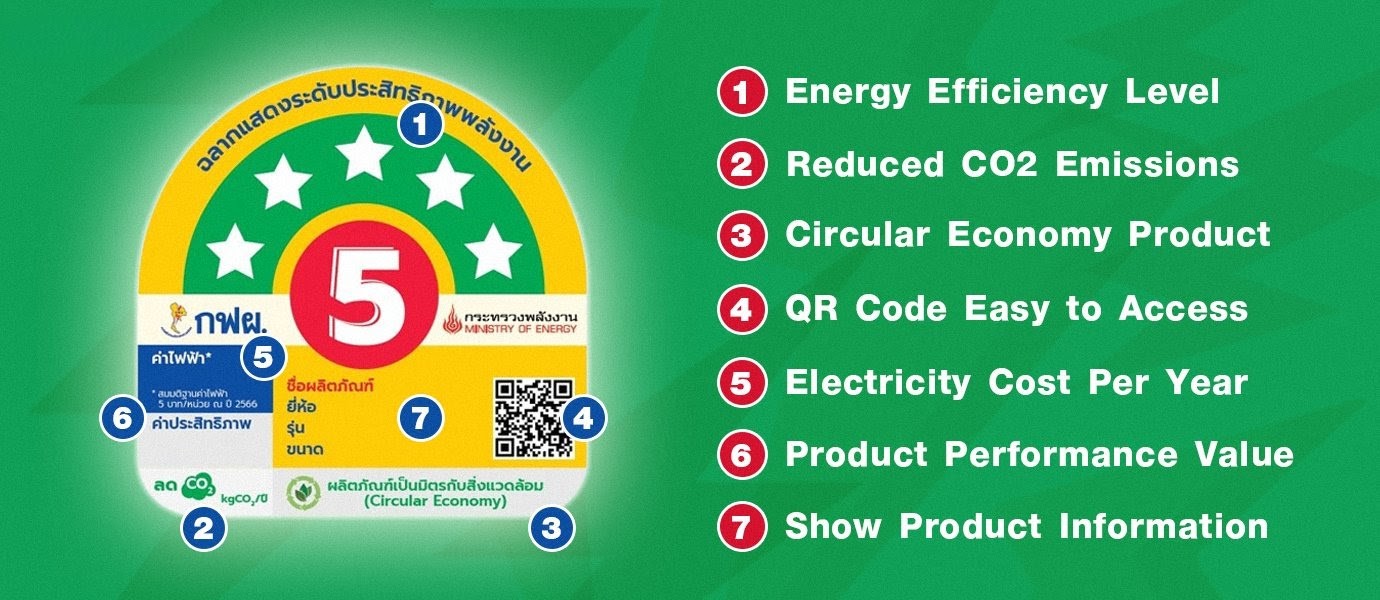
The No. 5 Label: Choosing the Right Unit
Air conditioners sold in Thailand carry a yellow energy efficiency label, rated from 1 to 5. The higher the number, the more efficient the unit. A “No. 5” (5-star) appliance can consume up to 30-40% less electricity than a basic model at equivalent cooling power.
When buying or renting a furnished property, check the AC labels. An old non-inverter unit with no performance rating can cost twice as much to run as a modern model.
Inverter vs. non-inverter: inverter-type air conditioners continuously adjust their output to the ambient temperature, rather than switching on and off abruptly. They consume on average 30% less energy for the same thermal result. If you’re buying an AC unit in Thailand, always choose an inverter model.
Filter Cleaning: The Forgotten Maintenance
In Thailand, dust and humidity clog AC filters much faster than in Europe. A blocked filter forces the motor to work harder, increases electricity consumption by 10 to 25%, and degrades indoor air quality.
Practical recommendation:
- Filter cleaning: every 2 weeks (rinse with water, let dry, replace — 10 minutes)
- Professional service (full cleaning, refrigerant check): every 6 months
- An AC technician’s home visit typically costs between 500 and 800 THB for a full clean
Other Effective Habits
- Thick curtains or blinds on west and south-facing windows — reducing direct sunlight can lower indoor temperature by 2-3°C without extra cooling
- Switch off standby appliances — TVs, internet boxes, and chargers on standby represent a non-negligible annual bill in Thailand
- Instant vs. storage water heater — if you have the choice, the instant model only consumes electricity during use, without maintaining temperature all day
Solar Energy in 2026: A Serious Option
For expats in standalone houses (rather than apartments), solar panel installation has become a financially viable option in 2026, particularly thanks to the continuing decline in battery prices.
Thailand’s Net Metering System
Thailand has a solar electricity feed-in system (Net Metering). Homeowners with solar systems can inject surplus electricity into the MEA or PEA national grid and receive a credit on their next bill. The current buy-back rate is approximately 2.20 THB/kWh — less than the purchase rate, but significantly reducing the net bill.
A 3 kWp system for a medium-sized house costs between 80,000 and 130,000 THB installed in Thailand. With current tariffs and good sun exposure (which Thailand certainly doesn’t lack), the return on investment is typically 5 to 8 years.
Government Support
Low consumption subsidy: households consuming less than 300 kWh per month benefit from a preferential progressive tariff. This measure primarily targets low-income Thai households, but any residential subscriber below this threshold benefits automatically.
The Clawback mechanism: since the energy price crisis of 2022-2023, the ERC uses surplus revenues from electricity authorities to cushion tariff increases. It’s this mechanism that limited the May 2026 increase to 1.8% instead of the theoretical 18%. There’s nothing to do to benefit from it — it’s automatically built into the Ft calculation.
Summary: What to Check Before Signing Your Lease
| Situation | Indicative rate |
|---|---|
| Direct MEA/PEA billing | 3.95 THB/kWh (May 2026) |
| Legal landlord rate (official) | 3.95 to 4.50 THB/kWh |
| Landlord with surcharge (common) | 6 to 8 THB/kWh |
| Serviced apartment / residential hotel | 8 to 10 THB/kWh |
Rates above the official tariff are legally contestable for any landlord managing 3+ units.
Rates valid May-August 2026, excluding 7% VAT.
— Mário Ferreira | Surin, Isaan, Thailand