A Hospital Far, Far Away…
📢 Transparency: Some links in this article are affiliate links. If you use these services, I earn a small commission at no extra cost to you. I only recommend tools I use myself.
In Thailand, eating street food is almost compulsory. The variety is endless and it’s so cheap! Every day I go to the market or stop at a street vendor to buy lunch or dinner. And it’s safe — have you ever had any “problems”? Yes, it’s safe — and yes, I did have a “problem” once… And today I’m going to tell you about it.
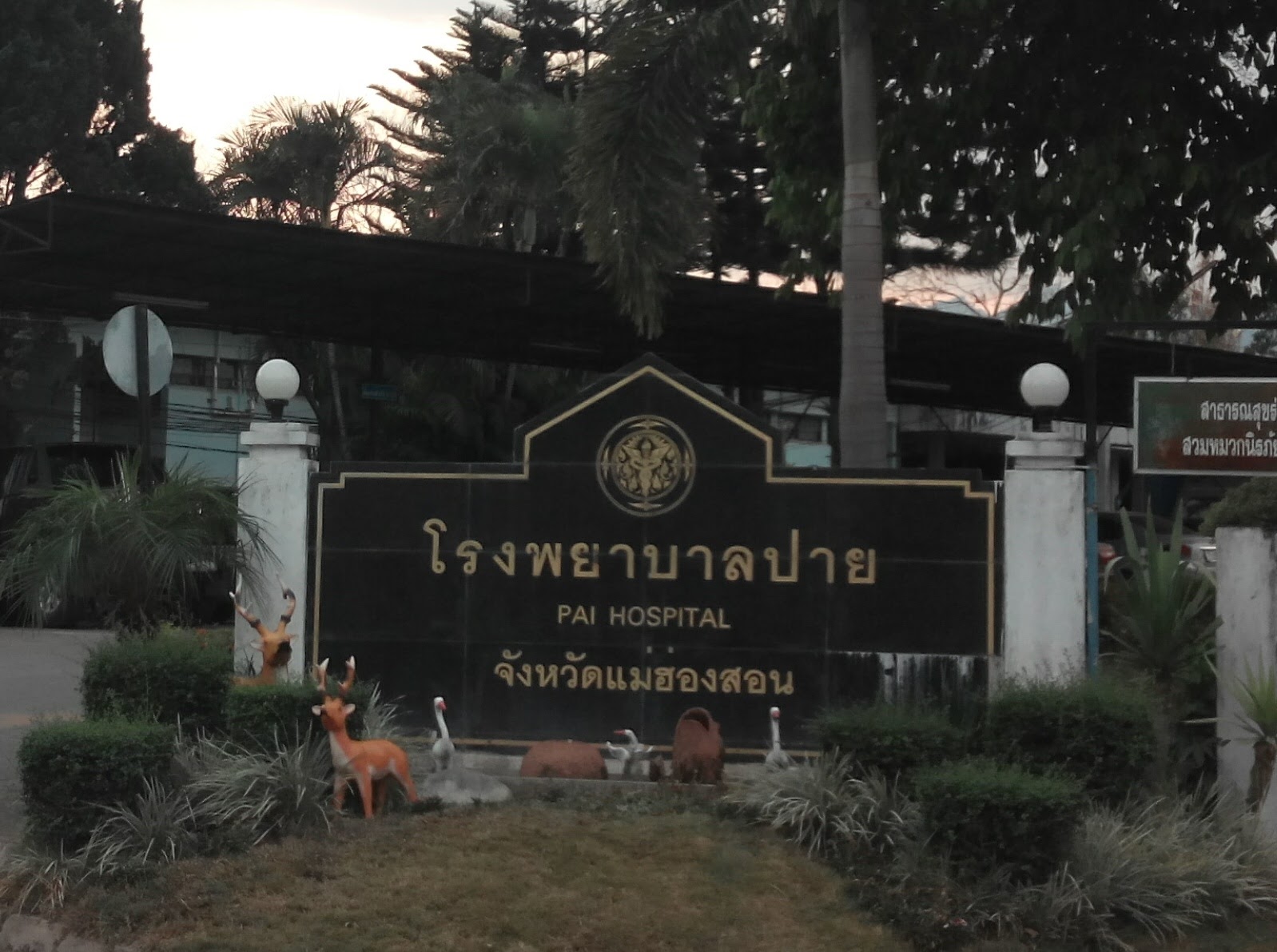
I was in Pai, a small village in northern Thailand near the Myanmar border, about 140 km and more than 700 bends and hairpin turns from Chiang Mai. After a magnificent green chicken curry eaten right there at the night market, I had the unfortunate idea of finishing the evening with a banana pancake…
What happened that night, I’ll spare you the details. What really worried me was waking up flat on the bathroom floor. I had fainted while shaving. I quickly asked for help getting to the hospital, and it was by moto-taxi(!) that I was admitted to the emergency room. I remember managing to fill in my admission form, hauling myself onto the free stretcher nearby, and seeing four nurses gathered around me. One of them was desperately trying to take my blood pressure…
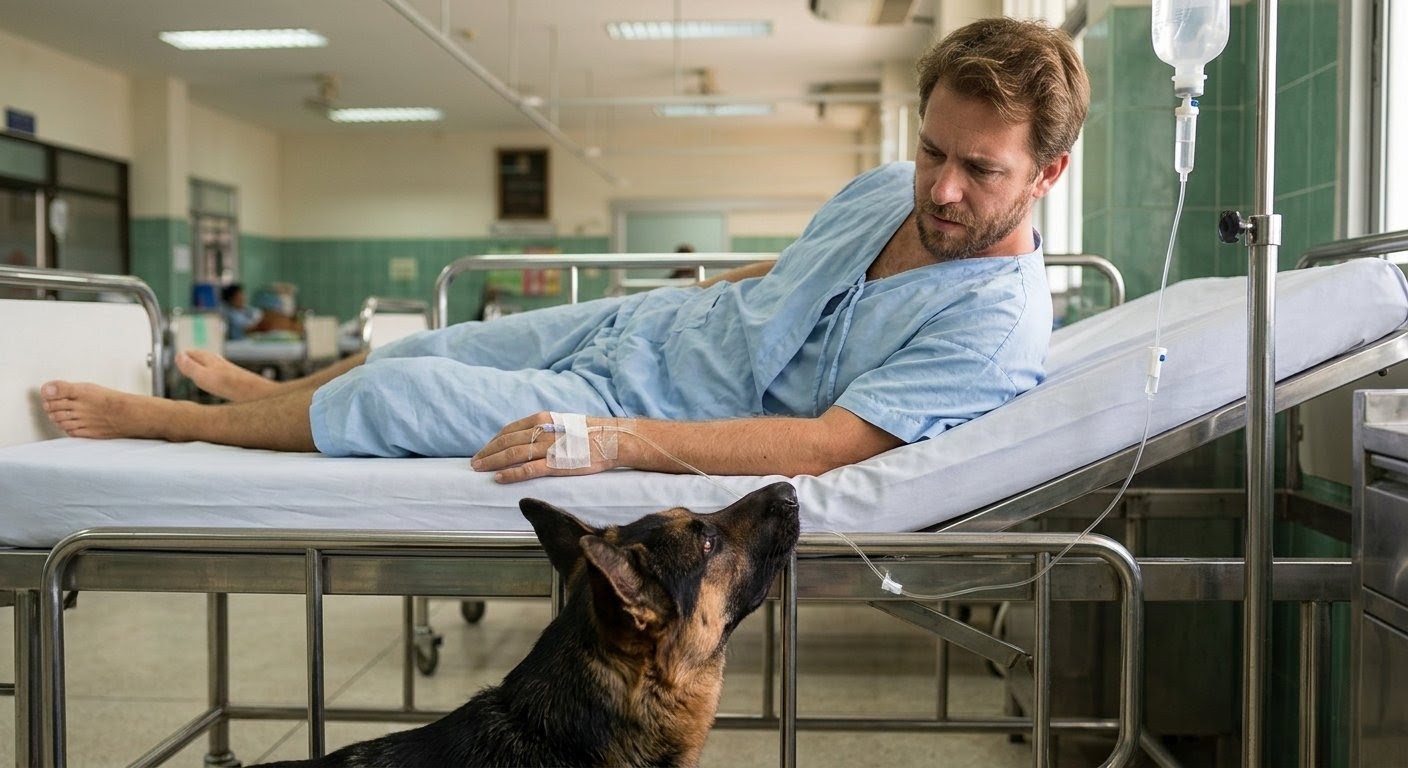
I opened my eyes and the nurses had gone. I was in a ward with five Thai patients who were looking at me with relieved smiles at seeing my eyes open. I looked around. I was on a drip, but… something under my bed was pushing up the mattress. I leaned over and saw… an enormous German shepherd staring up at me with pricked ears! It was him, using his muzzle to lift my mattress. That’s when I really got worried. I was hallucinating! I must have had a high fever. I did — but the dog was real! Later that day, I heard someone calling “Bobby, Bobby!!” (in Thai, of course!) and off he went home with one of the hospital staff. The next day, Thai Bobby was back on duty to wake me up.
I spent three nights in the hospital. I have to say I was treated extremely well — professionally, warmly, and efficiently. That’s the image I have of Thai public hospitals.
A few memories from that episode:
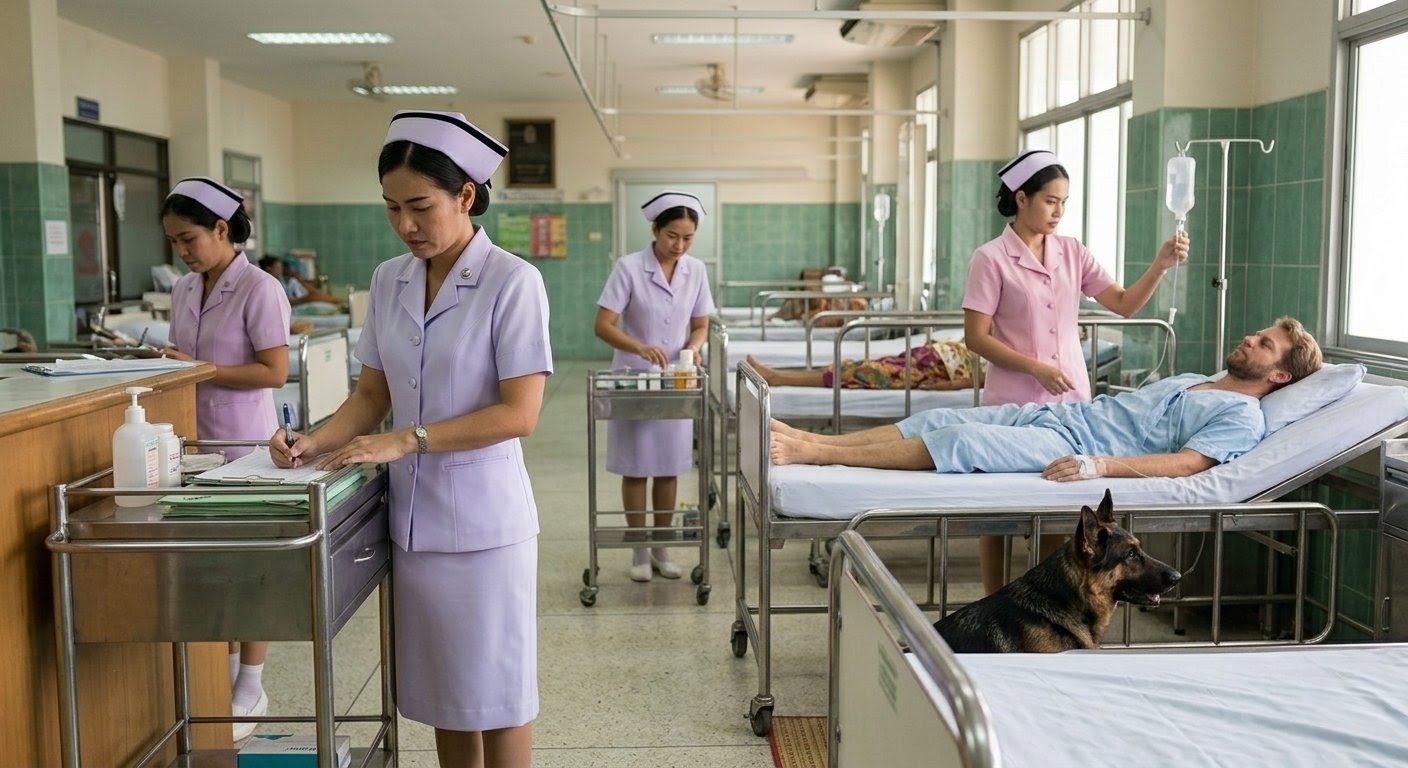
1. The nurses’ uniforms — They are always impeccably dressed in pink or lilac with a cap on their heads. They look like they’ve stepped out of an old Hollywood war film.
2. The canteen lady, who tried so hard to get me to eat… I remember the first breakfast she brought me — typically Thai. I told her I couldn’t eat and asked for just a coffee or tea. She smiled with the air of someone who has exactly what you need, went to the kitchen, and came back with… a hard-boiled egg and a banana.
3. The young girl with Minnie Mouse ears holding her hair back, who came regularly to take my temperature. She would note the value on a sheet of paper and walk away looking very sad. Until one reading when she gave me the most beautiful smile I saw in that hospital and said in English: “No fever, very good!”
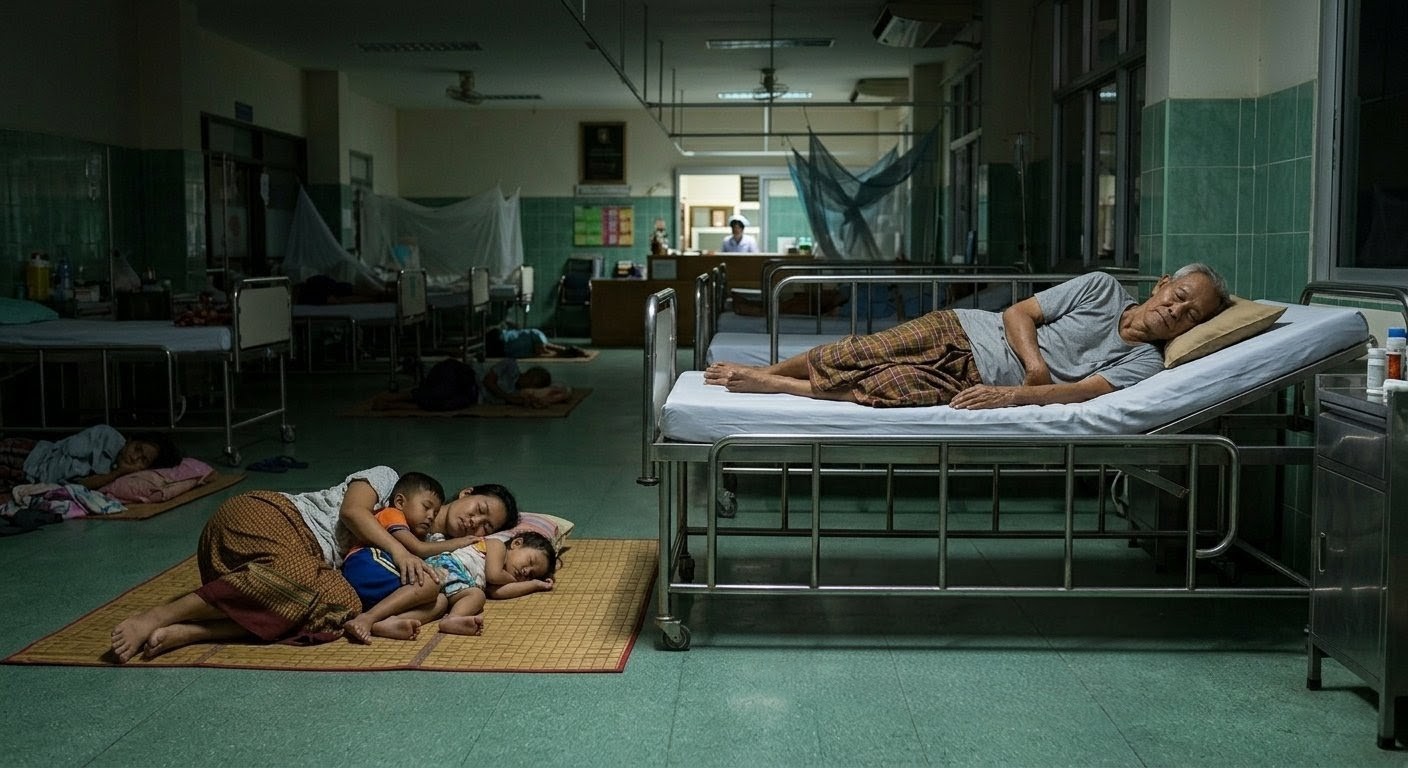
4. The number of people sleeping in that ward! Not just the 6 patients — visiting hours were 24 hours a day, and at night, the closest family members would spread a mat on the floor and sleep right there. My neighbour always had his wife and two children sleeping under his bed.
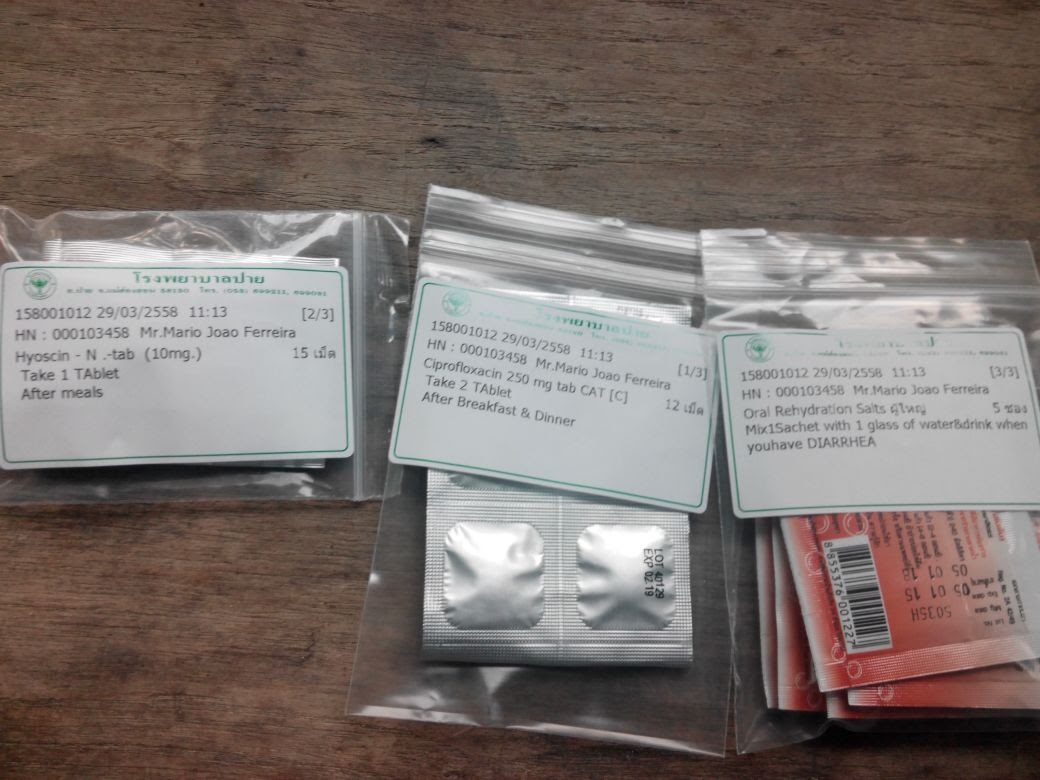
5. When I was discharged, several small bags of tablets were waiting for me, with instructions in English.
Thailand’s Healthcare System: What You Need to Know
My experience in Pai was in a public hospital, and it was a good one. But the Thai healthcare system has important nuances that every expat should understand before needing it in an emergency.
Public Hospital vs. Private Hospital
Thailand has a two-tier healthcare system, similar in structure to many European countries but with notable differences.
Public hospitals are run by the Ministry of Public Health and exist throughout the country, even in rural areas. Quality varies considerably: university hospitals in Bangkok or Chiang Mai rival private facilities, while rural district hospitals are more modest in equipment and specialist availability. The great advantage is price. The main drawbacks are waiting times and, in rural areas, the language barrier — English is rare outside the cities.
Private hospitals offer comfort, speed, English-speaking staff, and consistently high quality. Several are accredited by the Joint Commission International (JCI), the global benchmark. Costs are naturally higher — but still significantly lower than equivalent care in Europe or the US.
Who Gets Access to the Public System on Thai Terms?
This is the question most expats don’t ask until they urgently need the answer.
Thai citizens access the public system for free through the Universal Coverage Scheme (UCS), funded by taxes. For foreigners, access exists but is paid at a middle rate between what Thais pay and private hospital prices.
The important exception: foreigners on a work visa who contribute to the Thai Social Security Fund access the public system on the same terms as Thai workers — essentially free, with a designated hospital. It’s a real benefit, but limited to those formally employed by a Thai company.
Retirement visa (Non-OA) holders — the majority of long-term Western expats — do not have access to the subsidized public system. They pay the foreigner rates.
What It Actually Costs
Based on my experience in Surin and available data:
Public hospital — foreigner rates:
- General consultation: 50 to 300 THB
- Specialist consultation: 300 to 800 THB
- Emergency room: 500 to 2,000 THB, depending on complexity
- Hospitalization: significantly cheaper than private
Private hospital — price references:
- General practitioner consultation: 500 to 1,500 THB
- Specialist consultation at a private clinic (Surin): around 500 THB — the same price as a public hospital consultation, but with no waiting time and considerably more comfort
- Minor outpatient surgery: 5,000 to 15,000 THB. As a personal example: a one-hour procedure at the private hospital in Surin, with one doctor and three nurses, cost me 9,000 THB — under €250
- Private room: 4,000 to 10,000 THB per night, excluding treatment costs
National emergency number: 1669 (ambulance, free of charge).
The Health Insurance Question
Given the cost of hospitalization and complex procedures at private hospitals, health insurance is strongly recommended for any long-term expat — and is in fact mandatory for obtaining and renewing the Non-OA retirement visa.
For those still weighing their options, SafetyWing is one of the most flexible and accessible solutions for nomads and expats, with coverage including emergencies and hospitalization.
For more information on health insurance for expats in Thailand, see our dedicated article.
— Mário Ferreira | Surin, Isaan, Thailand