Thailand Investment Visa: Buying Property to Stay Long-Term
Since October 2025, a new pathway to long-term residence in Thailand has become available to foreigners: purchase real estate worth a minimum of 3 million baht and receive, in return, a renewable annual extension of stay. It’s a genuine development — and a concrete opportunity for many expats and investors.
But be warned: this scheme is surrounded by a great deal of property marketing and some misleading shortcuts online. This guide explains what actually exists, how it works, and what it is not.
What Is the Legal Basis?
Two orders from the Thai Immigration Bureau, in force since 1 October 2025, form the legal framework:
- Order 237/2568 — governs visa status alignment and change of category for the initial phase
- Order 238/2568 — governs the 12-month extension, eligibility criteria, and required documents
This is not technically a “visa” in the traditional sense: it is an investment-based extension of stay, renewable annually. In practice, the result is the same — you can remain in Thailand legally on a continuous basis.
The Three Qualifying Routes
Route 1 — Condominium Purchase (Freehold)
The most common and secure option.
- Minimum value: 3,000,000 THB (≈ €80,000 / $85,000)
- Must be a condominium unit within the foreign ownership quota (maximum 49% of the building)
- The property must be completed and registered in your name at the Land Office
- Off-plan properties do not qualify — the unit must physically exist and the official transfer must have taken place
- The seller must be a Thai individual or a Thai company with at least 51% Thai shareholding
Route 2 — Long-Term Lease (Leasehold)
For villas or houses, where freehold ownership is not available to foreigners.
- Minimum lease term: more than 3 years
- Total contract value: at least 3,060,000 THB
- The lease must be registered at the Land Office with you as the named primary tenant
⚠️ March 2026 update: additional requirements for the leasehold route are currently being developed, following attempts by certain agencies to exploit existing loopholes. Consult a legal professional before committing to this route.
Route 3 — Monthly Rental
- Minimum monthly rent: 85,000 THB (≈ €2,250/month)
- First application: minimum 3 months’ advance payment required
- Renewal: minimum 12 months’ advance payment required
This option suits those who do not wish to purchase property but want to secure long-term legal residence.
The Essential Step: Ministry of Tourism Certification
This is the point most articles overlook — and yet it is the most critical.
To access the 3 million baht threshold, you must obtain a Certification Letter from the Ministry of Tourism and Sports, issued through Thailand Longstay Service Co., Ltd. (TLS). This letter confirms your status as a “long-stay tourism supporter.”
Without this certification, immigration officers are legally required to apply the standard 10 million baht threshold instead. The certification is not automatic and must be obtained through an authorized operator.
How the Process Works
The process unfolds in several stages:
- Legal pre-check — your property structure, documents, and seller compliance are verified against Order 238/2568 requirements
- Operator verification — the file is submitted to the authorized long-stay operator (TLS); typically takes 7–10 business days; the Ministry Certification Letter is issued at this stage
- Phase 1 — 90-day permit — you attend Immigration in person; in Bangkok, the permit is typically issued on the day of the appointment
- Phase 2 — 12-month extension — filed before the 90-day permit expires; validity is 12–15 months for the first year, then 12 months for subsequent renewals
Required Documents
- Valid passport
- Purchase or lease contract
- Proof of payment (bank transfer statements)
- Title Deed in your name
- FET form (Foreign Exchange Transaction) — mandatory: funds must come from abroad
- Tabien Baan (Thai house registration book)
- Photos of yourself in front of the building, at the unit entrance, and inside the unit
- Google Maps screenshot of the property location
- Seller documents (Thai ID and/or company documents)
- Health insurance with minimum coverage of 400,000 THB for inpatient treatment
- Certified Thai translation of all foreign documents
Real Advantages of the Scheme
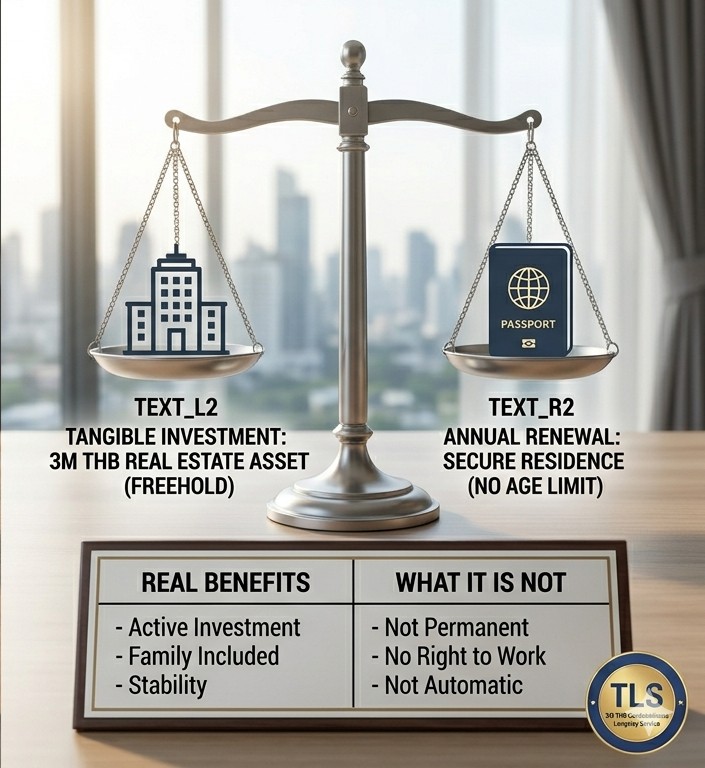
A tangible investment. Unlike the old Thailand Elite Visa (with non-refundable fees), your 3 million baht goes into an asset you own that can appreciate in value, generate rental income, and be sold when you choose.
Open to all ages. No minimum age of 50, unlike the retirement visa. Ideal for digital nomads, young families, or investors of any age.
Family included. Your spouse (legally married and living with you), unmarried children under 20, and biological parents over 50 can be included as dependents, without additional investment.
Stable renewal. As long as you maintain ownership of the property and comply with immigration requirements (including 90-day reporting), annual renewal is accessible.
What It Is Not — Essential Points
Not permanent residency. This scheme does not grant permanent residency, does not give the right to work in Thailand, and is not a pathway to Thai citizenship.
Not automatic. Buying a property does not automatically generate a visa. Each file is reviewed individually by Immigration.
Not uniform across the country. In Bangkok, Phuket, Pattaya, and Chiang Mai, immigration offices are familiar with the TLS procedure. In provincial offices, experience varies.
Additional fees apply. Expect approximately 27,000 THB per 12-month renewal cycle in programme administration fees, on top of standard immigration fees.
Funds must come from abroad. The FET form is mandatory. You cannot use locally earned Thai baht to fund the purchase if you wish to benefit from this scheme.
Still consolidating. As of March 2026, some procedural details were not yet fully stabilized. Consult a lawyer specializing in Thai property and immigration law before any decision.
Quick Comparison with Other Long-Stay Visas
| Scheme | Investment | Duration | Work permitted | Minimum age |
|---|---|---|---|---|
| Investment Visa 3M | 3M THB property | 1 year renewable | No | None |
| Non-OA Retirement | 500,000 THB in the bank | 1 year renewable | No | 50 |
| LTR Visa | Varies by category | 10 years | Yes (digital) | None |
| Thailand Privilege | 600,000 THB (fee) | 5 to 20 years | No | None |
| DTV (Digital Nomad) | 500,000 THB in bank | 5 years | Yes (foreign employer) | None |
Conclusion
The 3 million baht property investment visa is a real and attractive opportunity for those who are planning to buy property in Thailand anyway. The residence benefit then becomes a bonus rather than an additional cost. But it is not a magic formula: the process is administrative, the documentation is substantial, and the details continue to evolve.
Our advice: don’t let a visa decision be the primary reason for a property purchase. Buy because the property is a sound investment — and treat the visa as an added advantage.
This guide is provided for informational purposes only. Thai regulations can change rapidly. Consult a specialized lawyer before taking any steps.
— Mário Ferreira | Surin, Isaan, Thailand