Thailand Retirement Visa 2026 : The Complete Guide to Settling In
by Mario Ferreira | March 2026 | Visa & Administration
📢 Transparency: Some links in this article are affiliate links. If you use these services, I earn a small commission at no extra cost to you. I only recommend tools I use myself.
You are 50 or older, you have a European pension, and you dream of spending your retirement under the Thai sun? The retirement visa — officially the Non-Immigrant O-A (Long Stay) — is probably the most straightforward path to settling legally in Thailand.

I have lived in the Isaan region for over 3 years and have helped several fellow Europeans through the process. This guide brings together everything I wish I had known before arriving — the official rules, practical pitfalls, and details that official websites never mention.
💡 Author’s note: I hold a spouse visa (Thai wife visa), but I am fully informed about retirement visa requirements. The information below is current for 2026, but immigration rules can change — always verify with your local immigration office.
1. What is the Thai Retirement Visa?
The retirement visa is not an official Thai category — it is the popular nickname for the Non-Immigrant O-A (Long Stay) visa. There is also an O-X version, lesser known and rarely used.
Non-Immigrant O-A vs O-X — what’s the difference?
| O-A (standard) | O-X (long stay) | |
|---|---|---|
| Duration | 1 year, renewable | 5 years, renewable |
| Bank deposit | 800,000 THB | 3,000,000 THB |
| Health insurance | Mandatory | Mandatory |
| Availability | All consulates | Selected consulates |
For the vast majority of European retirees, the O-A is the standard route. The O-X is reserved for those with significant financial means.
2. Requirements
Minimum age
50 years old at the time of application.
Financial requirements — 3 valid options
- Option 1 — Bank deposit: 800,000 THB held in a Thai bank account
- Option 2 — Monthly income: 65,000 THB/month from pension or regular income
- Option 3 — Combination: deposit + income totalling 800,000 THB over the year
⚠️ Important detail for the first extension: the 800,000 THB must be present in your Thai account at least 2 months before your application. A recent rule mentions 3 months, which is mathematically impossible to meet if you entered on a 90-day visa. In practice, immigration offices still apply the 2-month rule. Check with your local office before making the deposit.
Bank balance maintenance rule
- Before the first extension: 800,000 THB for a minimum of 2 months
- After approval: maintain 800,000 THB for 3 months
- Rest of the year: minimum 400,000 THB in the account
- This rule applies to all subsequent annual renewals
💡 Practical tip: open your Thai bank account as soon as you arrive. Banks recommended by expats: Kasikorn Bank (KBank) and Bangkok Bank — the most accessible to foreigners.
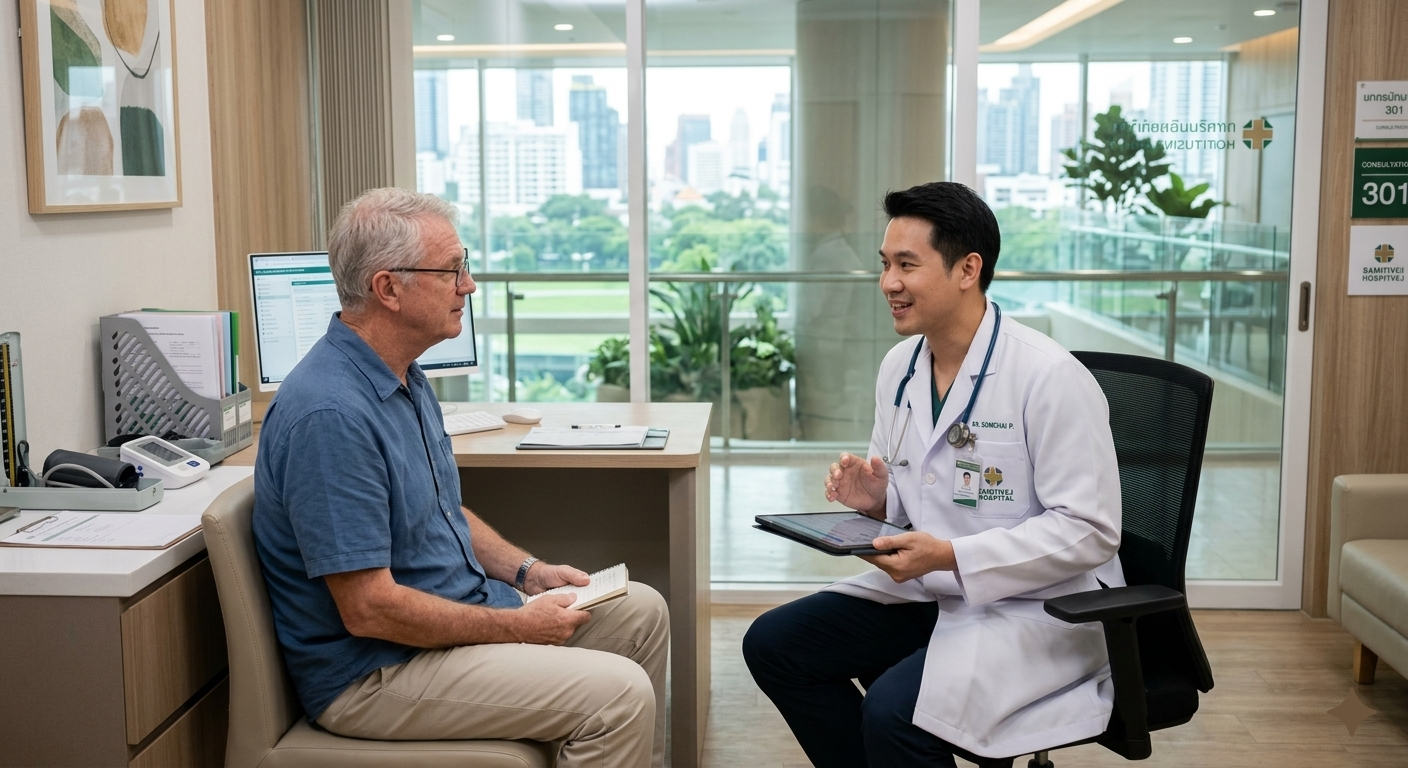
Health insurance — mandatory for O-A
- Minimum coverage: 100,000 USD or 3,000,000 THB (inpatient + outpatient)
- Insurance must cover general illness, including COVID-19
- Foreign Insurance Certificate completed, signed and stamped by the insurer — form at longstay.tgia.org
- International insurers (AXA, Cigna, SafetyWing) are accepted if listed on that site
⚠️ Insurance costs can be high. Compare SafetyWing, Cigna Global and AXA. Verify that your insurer issues the Foreign Insurance Certificate in the longstay.tgia.org format before signing.
🏥 SafetyWing — International coverage, monthly payments, no commitment. Ideal for expat retirees. → See pricing
3. How to Apply
Option A — From your home country (recommended)
Visit the Thai embassy or consulate in your country. Obtain the O-A visa directly — valid for 1 year from entry into Thailand. Simpler and cleaner administratively.
Option B — From Thailand (2-step process)
- Apply for a Non-Immigrant O visa (90 days) at the Thai embassy in your country before leaving
- Enter Thailand, open your KBank or Bangkok Bank account and deposit 800,000 THB
- After 60 days of stay, apply for the annual extension at the local immigration office
⚠️ It is no longer possible to convert a tourist visa or visa exemption into a retirement visa from inside the country.
⚠️ Rules vary by province
This is one of the least documented aspects of the Thai system: each provincial immigration office applies the rules in its own way. Document requirements, accepted timelines and even the interpretation of financial conditions can differ significantly between Chiang Mai, Pattaya, Surin and Hua Hin.
💡 My most important advice: before preparing your file, visit your provincial immigration office in person. Explain your situation and ask for their checklist. Officers are generally welcoming to well-intentioned foreigners and will give you a precise list of everything they require — sometimes different from what you’ve read online. This preliminary visit will save you an unnecessary round-trip.
Thailand Electronic Visa (e-Visa)
The official portal to submit your visa application online to the Thai Ministry of Foreign Affairs. Available for many European nationalities.
thaievisa.go.th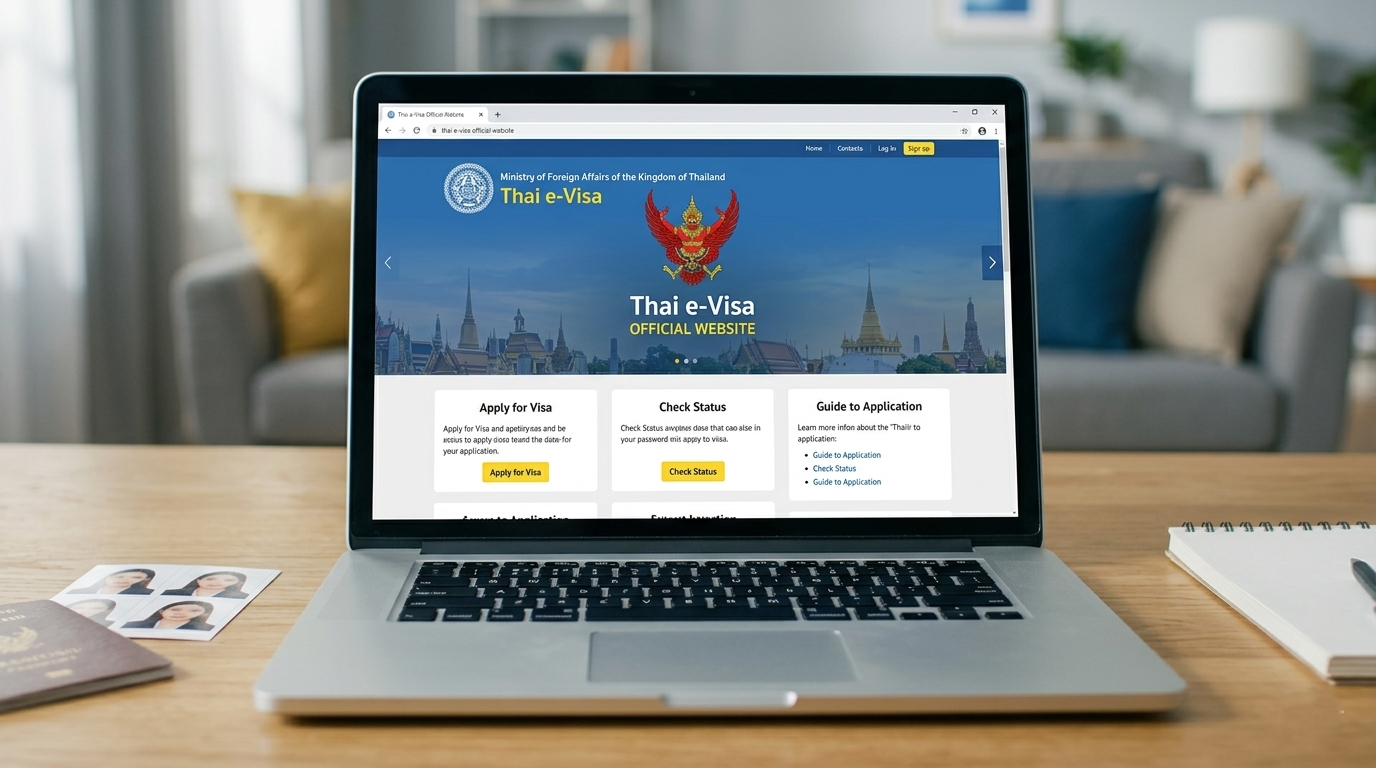
Required documents (basic list)
⚠️ This list is indicative. Always ask your local immigration office for their official checklist — it may include additional province-specific requirements.
- Valid passport (minimum 18 months remaining validity)
- TM.7 application form (available at the immigration office)
- 2 recent passport photos (4×6 cm)
- Financial proof: Thai bank statement or pension certificate
- Foreign Insurance Certificate completed and stamped by insurer (form: longstay.tgia.org)
- Clean criminal record (for initial application from abroad)
- Medical certificate (max 3 months validity) confirming absence of prohibitive conditions under Ministerial Regulation No. 14

4. Annual Renewal
Where to renew?
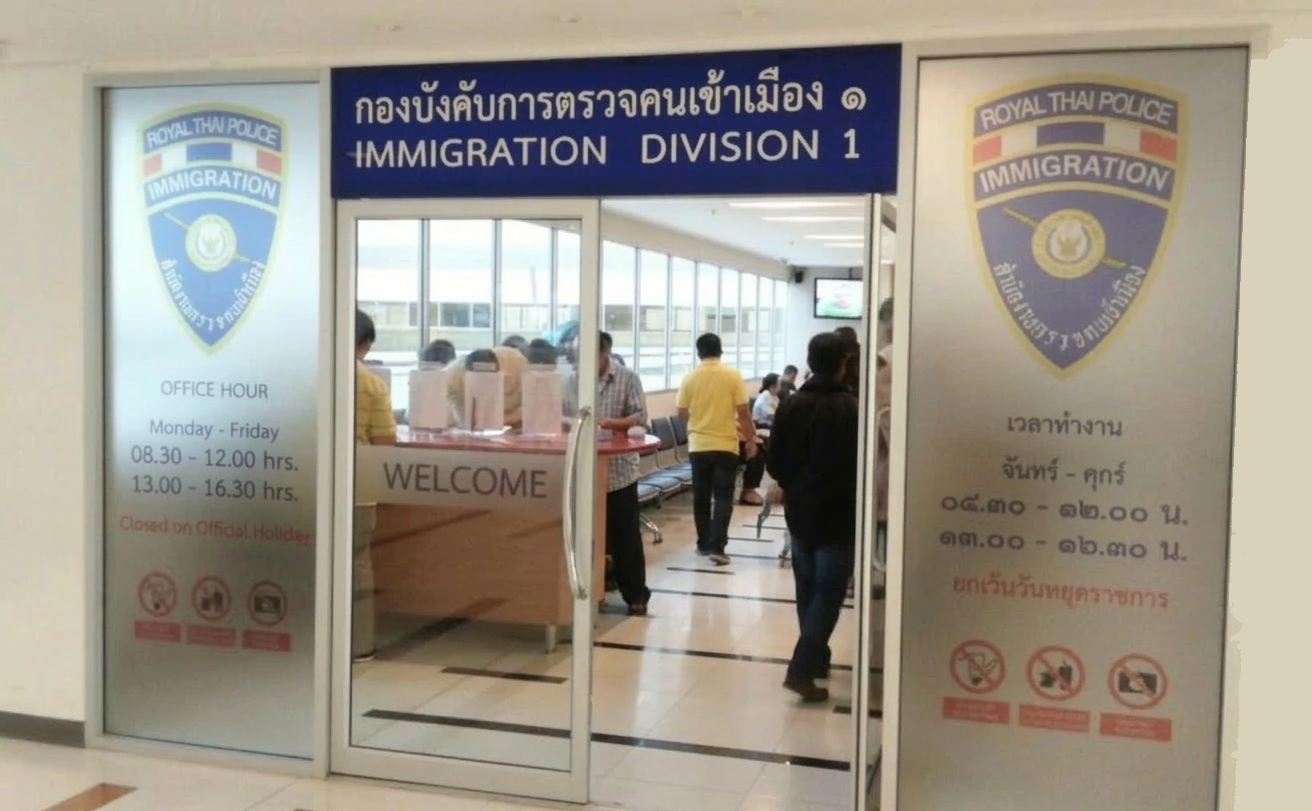
Annual renewals are done at local immigration offices — no need to go to Bangkok. Each province has its own office. In Surin, Chiang Mai, Hua Hin or Pattaya, the local office handles these applications perfectly.
When to renew?
- You can submit your application up to 30 days before your visa expires
- Never exceed the expiry date — overstay is penalised (500 THB/day and territory ban)
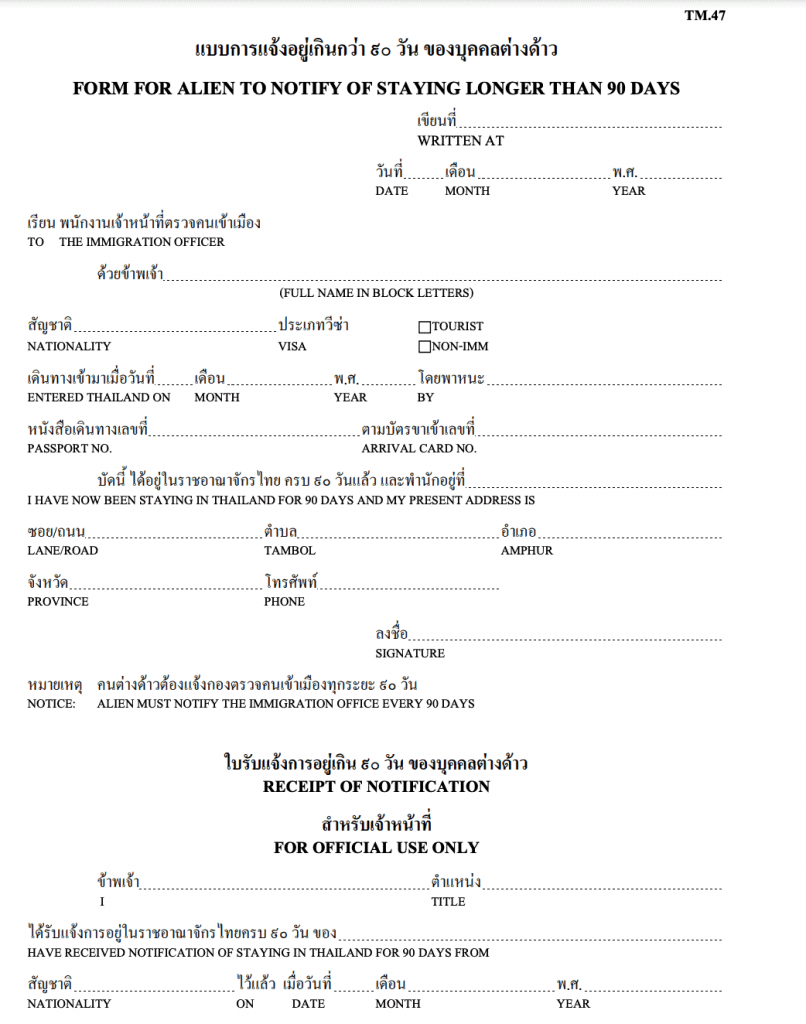
The 90-day report — quarterly obligation
Every long-stay visa holder must report their residential address to immigration authorities every 90 days. Three options:
- In person at the local immigration office
- By registered mail
- Online at immigration.go.th (varies by office)
📍 Field advice: online reporting works inconsistently across regions. In Surin and many Isaan offices, physical presence is often still required. Allow a half day.
5. What Does It Really Cost?
| Item | Cost |
|---|---|
| O-A visa fee (consulate) | 2,000 THB (~€50) |
| Annual extension (immigration) | 1,900 THB (~€47) |
| Annual health insurance | 30,000–80,000 THB depending on age |
| Immobilised bank deposit | 800,000 THB (~€20,000) — recoverable |
| 90-day report | Free |
| Annual total (excl. deposit) | ~17,000–42,000 THB |
💳 Wise — Transfer your pension at the real exchange rate. Save €20–40 on every €1,000 transfer. → Open a free account
6. Premium Alternative: the LTR Wealthy Pensioner Visa
For retirees with significant income or assets, Thailand has offered an alternative to the O-A since 2022: the Long-Term Resident Visa (LTR), Wealthy Pensioner category.
What the LTR offers
- Duration: 10 years (renewable), vs 1 year for O-A
- Multiple re-entry included — no re-entry permit needed
- Access to a dedicated lane at Thai airports
- Tax benefits since 2024: foreign income transferred to Thailand is exempt from Thai income tax
- Centralised administrative processing by the Board of Investment (BOI) — less provincial bureaucracy
Financial requirements
| Criterion | Requirement |
|---|---|
| Annual income | USD 80,000/year minimum |
| OR combination | USD 40,000/year + USD 250,000 investment in Thailand |
| Health insurance | USD 50,000 minimum coverage |
Who is it for?
The LTR Wealthy Pensioner is relevant if you receive a comfortable pension (senior executives, liberal professions, former directors), if you plan to invest in Thailand, or if 10-year stability without annual renewal has value for you. For the majority of European retirees, the O-A remains the appropriate route.
7. My Personal Advice
- Open your Thai bank account first. This is the number one blocking point. KBank and Bangkok Bank are the most accessible for foreigners. Bring your passport, visa and proof of accommodation.
- Don’t transfer the 800,000 THB too early. Wait until you are 2 months from your extension application.
- Choose your insurance carefully. Verify that your insurer issues the Foreign Insurance Certificate in the longstay.tgia.org format and that coverage reaches 100,000 USD, including COVID-19.
- Visit your local immigration office before preparing your file. Rules vary by province. A preliminary visit lets you get their exact checklist and avoid unnecessary rejections.
- Build a relationship with your local immigration office. In the provinces, officers are generally welcoming and patient with well-prepared foreigners.
- Learn a few words of Thai. Even basic ones completely change the reception you get at immigration counters.
8. FAQ — Frequently Asked Questions
Can I work on a retirement visa?
No. The O-A visa does not authorise paid work in Thailand. To work legally, a separate Work Permit is required.
Can I leave and re-enter Thailand freely?
Yes, but be careful: each departure from the country requires a re-entry permit if you wish to keep your current visa. Request one at the immigration office before leaving (1,000 THB for a single entry, 3,800 THB for multiple).
Is my European pension sufficient as financial proof?
Yes, if it reaches 65,000 THB/month (~€1,600). An official certificate from your pension fund, translated into English, is generally accepted.
What happens if I fall ill and exceed my insurance limits?
Private Thai hospitals are excellent but can be very expensive without sufficient coverage. I recommend inpatient coverage of at least 1,000,000 THB for peace of mind.
Does the retirement visa grant permanent residency?
No. The O-A is a temporary stay visa that can be renewed annually. Permanent Residency is a separate, long and complex process.
In Summary
The Thai retirement visa is accessible, well-structured and perfectly suited to European retirees with a reasonable pension or savings of 800,000 THB. The process may seem complex on paper, but in practice — with good preparation and a preliminary visit to your local immigration office — it is entirely manageable.
For more affluent profiles, the LTR Wealthy Pensioner offers a 10-year alternative with real tax advantages since 2024.
If you have specific questions about life in Surin, in Isaan, or about practical procedures in this region, feel free to leave a comment below.
— Mário Ferreira | Surin, Thailand
💬 Found this article useful? Leave a comment below — your questions help improve the guide!
📌 Also read: Opening a Bank Account in Thailand and our Cost of Living guide for Isaan.